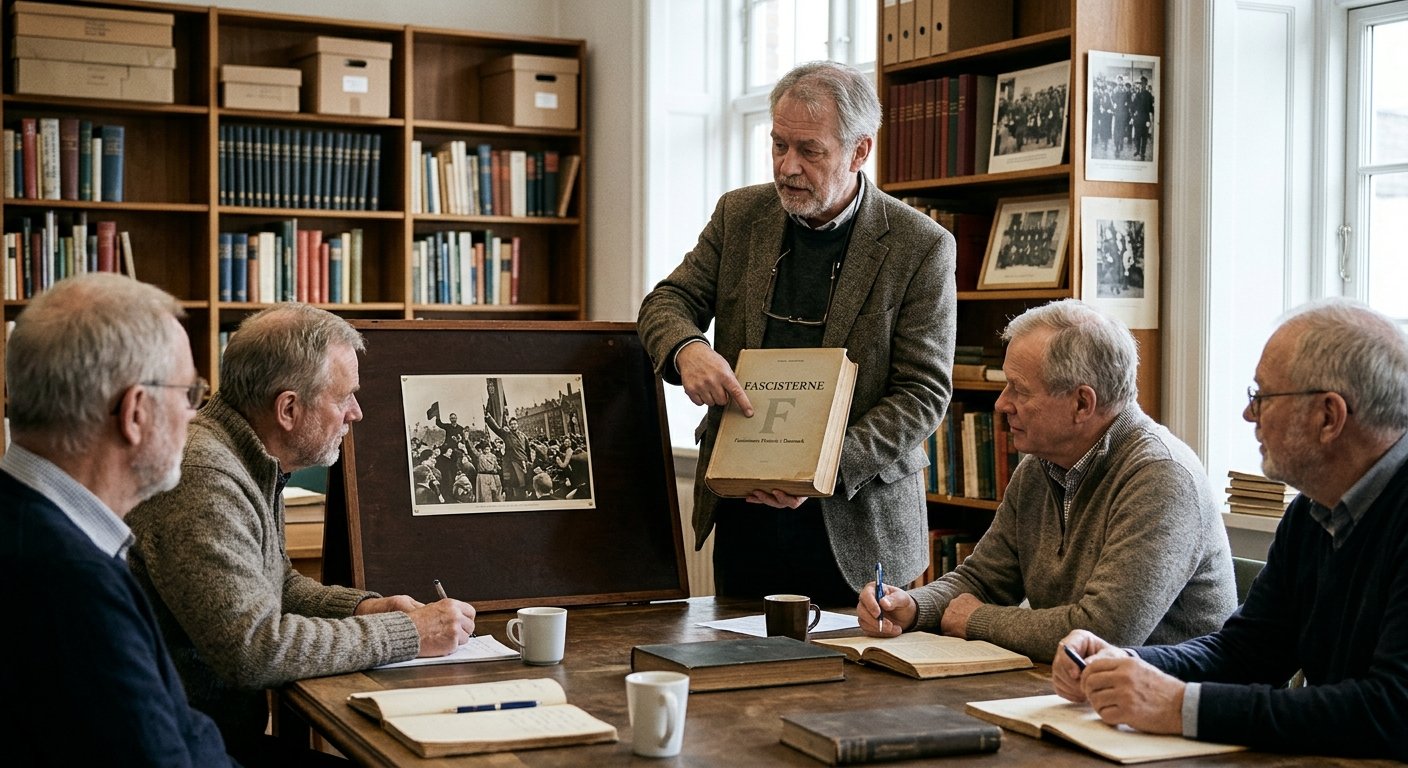
The word Fascisterne comes from Danish and translates into English as “the fascists.” Although it looks like the name of a particular organization, it is actually a descriptive word used for people associated with fascism. Its meaning becomes clearer when viewed through the language, political movements, and European history connected to it.
For readers encountering the term in historical documents, online discussions, or articles about World War II, understanding its background requires more than a direct translation. Fascisterne connects to the rise of authoritarian political movements in twentieth-century Europe, the dictatorship of Benito Mussolini in Italy, Nazi Germany, and the smaller but historically significant fascist and Nazi movements in Denmark.
There is also an important distinction between Fascisterne and fascism itself. The first describes people, while the second refers to a political ideology and movement. Understanding that difference helps readers interpret the word accurately without confusing historical facts with modern political arguments.
What Does Fascisterne Mean?
Fascisterne is a Danish word that means “the fascists” in English. It is the definite plural form of the noun fascist, which describes someone who supports or belongs to a fascist movement.
In Danish, definite articles are often expressed through word endings rather than separate words. This explains why Fascisterne looks different from its English translation.
The basic word forms are:
| Danish word | English meaning |
|---|---|
| Fascist | A fascist |
| Fascisten | The fascist |
| Fascister | Fascists |
| Fascisterne | The fascists |
| Fascisme | Fascism |
| Fascistisk | Fascist or fascistic |
The distinction between these words matters. Fascisterne does not identify one particular political party, historical leader, or organization. Its meaning depends on the surrounding sentence.
For example, a Danish history book discussing Italy during the 1920s might use Fascisterne to describe supporters of Mussolini. A discussion of Denmark during World War II could use the same word when referring to Danish fascists.
The Danish Dictionary, published through Ordnet, recognizes the word fascist as referring to a supporter of fascism. It also records the grammatical ending used to form the definite plural.
Where Did Fascism Originate?
Fascism emerged as a major political movement in Europe during the period surrounding World War I and its aftermath.
Italy became the birthplace of the first successful fascist movement. The country faced political instability, economic difficulties, social divisions, and dissatisfaction with the results of the First World War.
These conditions created opportunities for political groups promising national strength, order, and dramatic change.
One of the most influential figures was Benito Mussolini, who established the Fascist movement in Italy in 1919. His political organization eventually became the National Fascist Party.
Mussolini presented himself as a powerful national leader and promoted an authoritarian political system. His government weakened democratic institutions, restricted political opposition, and used propaganda to strengthen its position.
The Italian experience became an influential model for other authoritarian movements across Europe.
However, fascist movements were not identical in every country. Their policies, political structures, and relationships with existing institutions varied. Their shared characteristics included extreme nationalism, authoritarian leadership, hostility toward democratic opposition, and the subordination of individual rights to the state or nation.
The United States Holocaust Memorial Museum provides historical background on fascism and its development in twentieth-century Europe.
Who Was Benito Mussolini?
Benito Mussolini was the Italian political leader most closely associated with the original fascist movement.
Before entering national politics, he worked as a journalist and became involved in socialist politics. His political direction changed during World War I, and he eventually became the leading figure of Italian fascism.
In October 1922, the March on Rome helped Mussolini secure the position of prime minister. Over the following years, his government dismantled democratic political competition and established a dictatorship.
His regime relied on political propaganda, censorship, intimidation, and the suppression of opposition.
Mussolini also pursued an aggressive foreign policy, seeking to expand Italian influence beyond its borders. His government entered an alliance with Nazi Germany, and Italy became involved in World War II alongside Germany.
Mussolini’s political career ended during the final years of the war. His historical importance comes from his role in establishing fascism as a major political force and influencing similar movements elsewhere.
What Were the Main Beliefs of Fascist Movements?
Although different fascist organizations had their own national characteristics, several political ideas appeared repeatedly.
Extreme Nationalism
Fascist movements placed the nation above individual interests. They often promoted the belief that national unity required strict political and social control.
This approach frequently excluded people considered different, undesirable, or outside the movement’s definition of national identity.
Authoritarian Leadership
Fascist systems concentrated political authority around a powerful leader. They rejected the idea that government should remain accountable through genuine democratic competition.
Independent political institutions and opposition parties were treated as obstacles to the leadership’s authority.
Rejection of Democratic Opposition
Fascist governments restricted political freedoms and weakened institutions that could challenge their power.
Opposition newspapers, political organizations, and independent voices faced censorship or repression.
Propaganda and Political Control
Propaganda played an important role in fascist political systems. Governments used controlled media, public messaging, and political events to promote their ideology and strengthen support for their leaders.
These methods helped create an environment in which independent criticism became increasingly difficult.
Militarism and Political Violence
Many fascist movements celebrated military strength and accepted political violence as a means of advancing their objectives.
This connection between nationalism, military power, and authoritarian government contributed to the destructive consequences of fascist expansion in Europe.
Fascisterne and Denmark: What Happened During World War II?
Denmark has an important place in the history of European fascist movements, although its experience differed significantly from that of Italy and Germany.
The best-known Danish Nazi organization was Danmarks Nationalsocialistiske Arbejderparti (DNSAP), translated as the National Socialist Workers’ Party of Denmark.
The party was established on November 16, 1930, under the leadership of Cay Lembcke. Its political program and organization were heavily influenced by Adolf Hitler’s German Nazi Party.
DNSAP promoted nationalism, antisemitism, and opposition to parliamentary democracy. Its political identity closely followed the German Nazi model.
Frits Clausen became the party’s leader in 1933 and remained its most prominent figure for much of its existence.
Did Denmark Have a Fascist Political Party?
Yes. DNSAP was Denmark’s most prominent Nazi party during the 1930s and 1940s.
However, its existence should not be confused with widespread public support for its political program.
The party struggled to gain significant electoral influence. It first entered the Danish parliament in 1939, winning three seats with approximately 1.8 percent of the vote.
Even during the German occupation, it failed to become a dominant political force.
According to the historical account published by Lex, DNSAP received approximately 2.1 percent of the vote in the 1943 parliamentary election, retaining three seats.
These results demonstrate the difference between an organized extremist movement and the political preferences of the wider population.
Denmark Under German Occupation
Germany occupied Denmark on April 9, 1940. The occupation created a difficult political situation for the Danish government and population.
DNSAP hoped the German occupation would create an opportunity for the party to take control of the country.
German authorities provided the organization with financial assistance and political attention, particularly during the early years of occupation. Nevertheless, they did not install DNSAP as Denmark’s government.
The party’s limited popularity and Germany’s practical political calculations prevented it from achieving its ambitions.
Denmark’s wartime experience also included resistance, collaboration, political negotiation, and efforts to protect people targeted by Nazi persecution. These different experiences are important when examining the country’s history rather than treating the entire population as politically identical.
What Happened to DNSAP After World War II?
Following Germany’s defeat in 1945, DNSAP lost its political position and eventually dissolved.
Its members experienced different consequences depending on their individual actions. Some faced social and professional repercussions, while people involved in specific acts of collaboration could face legal proceedings.
The party’s history remains an important subject for Danish historians studying political extremism, occupation, and collaboration.
What Is the Difference Between Fascism and Nazism?
Fascism and Nazism are closely related political movements, but the terms are not interchangeable in every historical context.
Fascism first developed as an organized political movement in Italy under Mussolini. Nazism developed in Germany under Adolf Hitler and incorporated its own distinctive racial ideology.
Both systems rejected liberal democracy, promoted authoritarian leadership, and used propaganda and political repression.
However, Nazi ideology placed particularly strong emphasis on antisemitism, racial hierarchy, and the idea of racial purity. These beliefs became central to the persecution and mass murder carried out by the Nazi regime.
The distinction matters because describing every fascist movement as identical to Nazism can obscure important historical differences.
| Feature | Italian Fascism | German Nazism |
|---|---|---|
| Main leader | Benito Mussolini | Adolf Hitler |
| Country of origin | Italy | Germany |
| Political system | Authoritarian dictatorship | Totalitarian dictatorship |
| Nationalism | Extreme Italian nationalism | Extreme German nationalism |
| Racial ideology | Varied over time | Central to Nazi ideology |
| Historical period of rule | 1922–1943, with a later German-backed regime | 1933–1945 |
Both movements caused enormous suffering and contributed to the destruction of democratic institutions and international stability.
Why Is Fascisterne Still Relevant Today?
Fascisterne remains a meaningful term for people studying Danish language, European history, and political movements.
It appears in historical discussions about Mussolini’s Italy, Nazi Germany, Danish political organizations, and the wider European experience between the two world wars.
The term also appears in modern political discussions, although its meaning is sometimes used less precisely.
Calling someone a fascist is a serious political description. It should not automatically be applied to every person with conservative, nationalist, strict, or authoritarian views.
A careful assessment requires examining a movement’s ideology, political objectives, treatment of opposition, and relationship with democratic institutions.
Understanding the historical meaning of Fascisterne helps readers distinguish between a documented political movement and a loose accusation used in everyday arguments.
It also shows why historical vocabulary matters. Words connected to dictatorship, persecution, and political repression should be used accurately rather than treated as interchangeable labels.
Conclusion
Fascisterne is a Danish word with a straightforward translation: “the fascists.” Its wider significance comes from the political movements and historical events associated with fascism across twentieth-century Europe.
From Mussolini’s dictatorship in Italy to Nazi influence in Denmark, the history behind the term illustrates how authoritarian movements developed and challenged democratic societies.
Understanding the difference between Fascisterne, fascism, and Nazism gives readers a more accurate foundation for interpreting historical documents and modern political discussions. Above all, the word deserves careful use because it refers to a serious chapter of European history, not simply a general description of political disagreement.
Frequently Asked Questions About Fascisterne
What does Fascisterne mean in English?
Fascisterne is Danish for “the fascists.” It is the definite plural form of the word fascist.
Is Fascisterne the name of an organization?
No. Fascisterne is an ordinary Danish noun, not the official name of one particular organization. The context determines which people or movement the word describes.
Is Fascisterne the same as fascism?
No. Fascisterne refers to people associated with fascism, while fascisme is the Danish word for the political ideology itself.
Did Denmark have fascists during World War II?
Yes. Denmark had several far-right and Nazi political organizations. The most prominent was DNSAP, founded in 1930 and heavily influenced by Hitler’s German Nazi Party.
Who founded the Danish Nazi Party?
Cay Lembcke founded Danmarks Nationalsocialistiske Arbejderparti on November 16, 1930. Frits Clausen became its leader in 1933.
Were fascists and Nazis the same?
Not exactly. Nazism was closely related to fascism, but it developed a distinctive racial ideology that placed antisemitism and racial hierarchy at its centre.
Why is Fascisterne used in historical writing?
The word is useful when Danish writers discuss fascist groups, their supporters, and their role in European history. Its meaning depends on the historical subject being discussed.