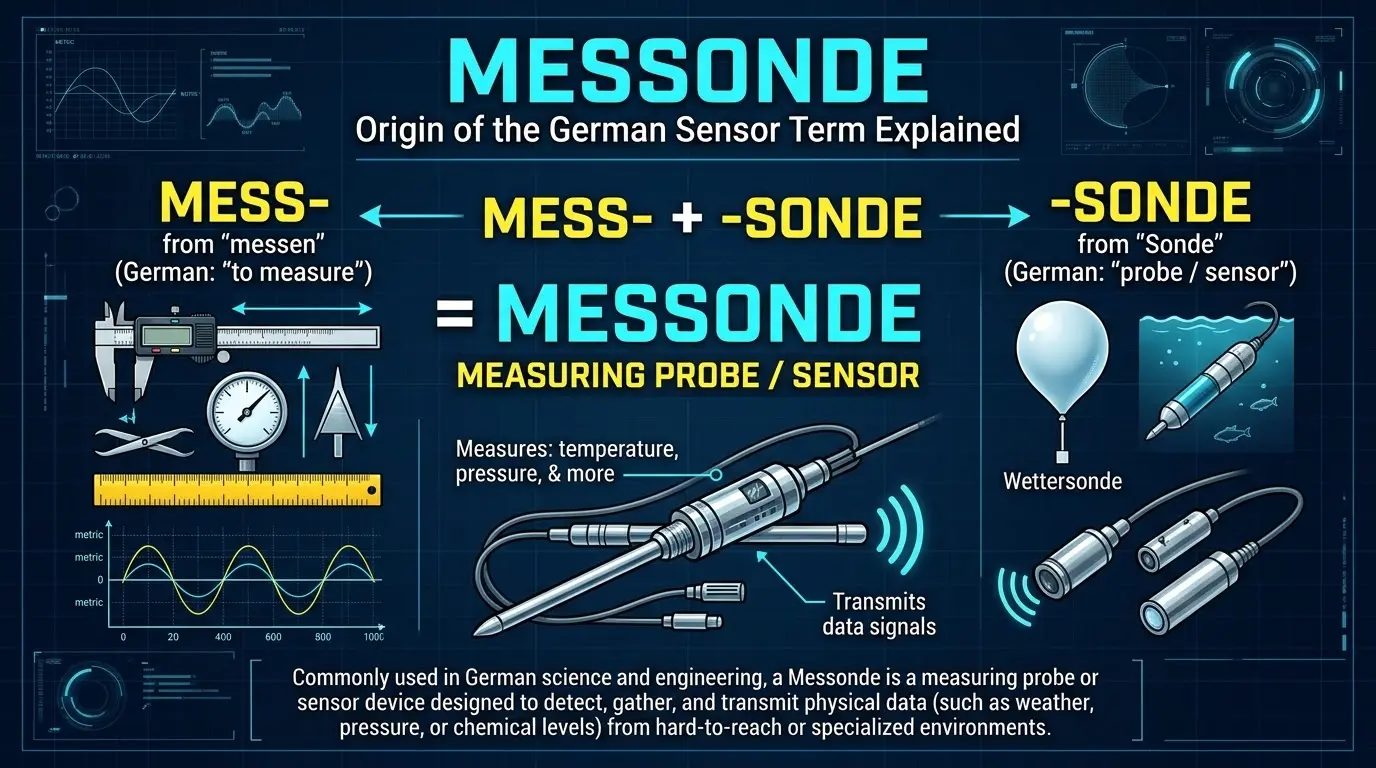
A single missing letter can make a familiar technical word surprisingly difficult to identify. Messonde is a German term found in engineering and patent documents, where it refers to a measuring probe or sensing device. Its more widely recognized modern German spelling is Messsonde, a compound word describing equipment used to measure physical or chemical properties.
The distinction is worth understanding. Messonde is not simply a meaningless internet expression or an invented name. Historical patent records contain the exact spelling, while German-English dictionaries document Messsonde as the established technical term.
For anyone encountering the word in a product description, scientific document, or translated instruction manual, the most useful English translation is usually measuring probe.
What Does Messonde Mean?
In a technical context, Messonde refers to a device or component that takes measurements from its surroundings.
Depending on its design, a measuring probe may detect temperature, electrical properties, acidity, oxygen concentration, or the movement of a fluid. It collects information that can be displayed, recorded, or used by a larger measuring system.
The standard German word, Messsonde, has several accepted English translations, including:
- Measuring probe
- Test probe
- Measurement sensor
- Measuring head
- Sensor, where the technical context supports that translation
The LEO German-English Dictionary records these translations, reflecting the variety of instruments that can be described by the term.
A Messsonde is not necessarily an entire measuring machine. It may be the component that comes into contact with a sample, sits inside a system, or detects a condition that another instrument processes.
That distinction becomes particularly important when reading equipment specifications.
The German Origin of Messonde
The meaning becomes clearer when the German word is separated into its components.
Mess- comes from messen, the German verb meaning “to measure.”
Sonde means “probe,” referring to an instrument used for examination, detection, or measurement.
Together, they form Messsonde: a probe designed to measure something.
Why Is Messsonde Spelled With Three S Letters?
Modern German normally preserves the letters of both components when forming this compound.
The first component, Mess-, ends in two s letters. The second, Sonde, begins with another s. Combining them produces Messsonde, with three consecutive s letters.
Although the spelling may look unusual to English readers, it follows the structure of the German compound.
An older spelling, Meßsonde, also appears in German dictionary records. The German-English dictionary dict.cc identifies it as an older form.
The shorter Messonde spelling is less standardized in contemporary dictionary usage, but it has an important documentary history of its own.
Is Messonde a Real Word or a Misspelling?
The answer requires a distinction between established dictionary spelling and recorded technical usage.
Messsonde is the standard German technical word. However, the exact spelling Messonde appears in historical engineering records, so it would be inaccurate to dismiss every occurrence as a modern typing error.
One particularly useful example comes from German patent documentation.
A Robert Bosch GmbH patent application filed in June 1977 and published in January 1979 carries the German title Messonde mit temperaturabhaengigem widerstand zur mengenmessung.
The invention concerns a measuring probe with a temperature-dependent resistor used in flow measurement.
The record, DE2728060A1, establishes that the shorter spelling was used in technical documentation decades before recent online discussions about the word.
Another example appears in a European patent associated with Mannesmann VDO AG. Its German title is simply Messonde, while the accompanying technical description concerns measuring the mass of a flowing medium.
That record, EP0235360B1, was published as a granted European patent in January 1990.
The spelling also appears in the European Patent Office’s June 2015 bulletin, which lists a bio-optical measuring device and measuring probe under a German title containing Messonde.
These records establish historical usage. They do not, however, prove that Messonde has replaced Messsonde as the preferred modern German spelling.
For contemporary technical writing, Messsonde remains the safer and more recognizable choice.
How Does a Messsonde Work?
There is no single operating principle shared by every measuring probe.
The mechanism depends on the property being measured and the environment in which the instrument operates.
A temperature probe, for example, may use a sensing element whose electrical characteristics change with temperature. An electronic instrument interprets that response and converts it into a temperature reading.
A pH probe works differently. Its sensing system responds to chemical conditions in a solution, allowing an associated meter to determine acidity or alkalinity.
Other probes use optical, electrochemical, or electromagnetic methods.
Despite these differences, the general process is similar:
- A sensing element interacts with the material or environment being examined.
- A measurable physical or chemical response occurs.
- The instrument converts that response into usable information.
- The resulting measurement is displayed, recorded, or transmitted to another system.
The probe itself is only one part of this process. Depending on the equipment, calibration, signal processing, and display functions may be handled by separate components.
Where Are Measuring Probes Used?
Measuring probes are found in many settings, from research laboratories to industrial machinery.
Laboratory and Water Testing
Laboratories use probes to measure properties such as pH, temperature, and dissolved oxygen.
For example, a pH electrode connected to a meter can help a technician evaluate the acidity of a water sample.
In environmental monitoring, related instruments provide information about water conditions and changes over time.
Germany’s Federal Agency for Nature Conservation includes measuring probes and devices in its marine terminology system, with examples such as CTD instruments, oxygen probes, and pH meters.
Automotive Engineering
Automotive applications provide a particularly clear historical connection to Messonde.
The Bosch and Mannesmann VDO patent records describe probes associated with fluid-flow measurement and temperature-dependent electrical components.
Such measurements can help electronic systems determine operating conditions within an engine or related equipment.
The exact design matters: an airflow probe, temperature sensor, and oxygen sensor may all belong to a vehicle’s measuring systems, but they do not perform the same function.
Industrial Process Monitoring
Industrial facilities use measuring probes to monitor conditions in production equipment, pipelines, tanks, and processing systems.
Depending on the application, probes may help operators observe temperature, chemical properties, or fluid conditions.
These measurements can support process control, quality checks, and maintenance decisions.
A probe’s usefulness depends not only on what it measures but also on whether it is suitable for the operating environment.
Messonde Pronunciation: How Do You Say It?
For the standard German term Messsonde, an approximate English-friendly pronunciation is:
MESS-zon-duh
The first part sounds like the English word “mess.” The second resembles the German word Sonde, with a voiced z-like sound at the beginning.
This is a practical pronunciation guide rather than a formal phonetic transcription.
Because Messonde is not the standard dictionary spelling, it does not have a separately established pronunciation that should be treated as universally authoritative.
When discussing the technical instrument in German, using the pronunciation of Messsonde is the clearest approach.
How to Use Messonde Correctly in English
English technical writing generally benefits from translating the German term rather than retaining it unnecessarily.
For example, a German instruction might read:
Die Messsonde misst die Temperatur im Wasser.
A natural English translation would be:
“The measuring probe measures the water temperature.”
Similarly, a product description mentioning a pH-Messsonde would normally refer to a pH measuring probe or pH electrode.
If an original patent or document specifically uses Messonde, preserving that spelling when quoting its title is appropriate. Changing the spelling inside an official title could make the record harder to locate.
In ordinary English explanations, however, measuring probe is usually more accessible.
Messonde vs. Messsonde: What Is the Difference?
| Term | Meaning and usage |
|---|---|
| Messonde | Historically documented technical spelling, including patent titles |
| Messsonde | Established modern German term for a measuring probe |
| Meßsonde | Older German spelling recorded in dictionaries |
| Measuring probe | Common English translation |
| Sensor | Broader English term that may apply depending on the instrument |
These expressions are closely related, but their spelling and context matter.
Someone researching a historical patent may need the exact term Messonde. Someone searching for a modern German product manual will generally find Messsonde more useful.
Why Does Messonde Have Different Meanings Online?
Unfamiliar words sometimes attract explanations that go well beyond their documented origins.
A technical term may be presented as a new digital platform, an abstract philosophy, or an innovative business concept without supporting documentation.
Messonde is especially vulnerable to this confusion because its spelling is uncommon and its German origin may not be immediately recognizable.
The available dictionary and patent evidence supports its connection with measuring probes. It does not establish a universal connection with a particular software platform, digital service, or philosophical system.
That does not prevent an organization from independently adopting the name. It simply means that any such use would need its own evidence.
Readers should distinguish between a documented technical meaning and a modern interpretation introduced by an individual website.
Conclusion
Messonde has a more substantial history than its unusual spelling might suggest. Historical patents establish its use in German engineering, while modern dictionaries identify Messsonde as the standard term for a measuring probe.
The essential distinction is between an attested technical spelling and the preferred contemporary form. Both point toward measurement technology, but their usage is not identical.
For readers translating a German manual, examining an older patent, or identifying an unfamiliar sensor component, understanding that distinction is the key to interpreting the term accurately.
Frequently Asked Questions
What is Messonde in simple English?
Messonde generally refers to a measuring probe in German technical contexts. The more established spelling is Messsonde.
Is Messonde a German word?
Yes, the exact spelling appears in historical German technical and patent records. Messsonde is the standard modern German dictionary form.
What is the difference between a Messsonde and a sensor?
A Messsonde is a measuring probe. A sensor is a broader category of device that detects a physical or chemical condition. A measuring probe may contain a sensor or function as part of a sensor system.
Does Messonde refer to a specific product?
Not necessarily. The term can describe different measuring instruments. A particular product must be identified through its manufacturer, model, and technical specifications.
What is the best English translation of Messonde?
“Measuring probe” is generally the most appropriate translation. Depending on the context, “test probe” or “measuring sensor” may also be suitable.